Friday May 31
Friends,
Happy Friday. This is my first time using an automated e-mail service so I hope this works. If you did in fact receive this, click the subscribe link and see if it takes you to a splash page with a subscription form. If so, thank Will Jones who helped me set that up!
Also, if you enjoy reading the Lens, please forward this edition to at least one person! It’d be very appreciative.
Let’s dig in.
Special Counsel Speaks
On Wednesday, for the first time since Deputy Attorney General Rod Rosenstein appointed him Special Counsel, Robert Mueller spoke publicly. For those who read the full Mueller report (or my summary Lens) his comments were unsurprising. But remember, the vast vast vast majority of Americans did not read a single word of the report. So making a public, televised statement gives the conclusions some, shall we say, clout.
My analysis is based on the statement itself, nothing else. You can read here or watch:
On Wednesday, for the first time since Deputy Attorney General Rod Rosenstein appointed him Special Counsel, Robert Mueller spoke publicly. For those who read the full Mueller report (or my summary Lens) his comments were unsurprising. But remember, the vast vast vast majority of Americans did not read a single word of the report. So making a public, televised statement gives the conclusions some, shall we say, clout.
My analysis is based on the statement itself, nothing else. You can read here or watch:
A large part of this statement was an effort my Mueller to refocus the American public on the report’s central finding: Russia engaged in a state-sponsored attack on America.
He states in the beginning of his remarks:
Russian intelligence officers who are part of the Russian military, launched a concerted attack on our political system.
As you know, they attacked in two waves. First, through hacking and releasing thousands of stolen emails and documents from the Clinton campaign and second, through a widespread fake news social media campaign to support candidate Trump and disparage candidate Clinton.
He starts (and ends) with the Russian aggression because he believes, rightfully so, that it is the most important part of the report. He also (probably) believes, rightfully so, that Congress has not done enough to make sure it does not happen again.
In the course of their investigation into election interference the special counsel concluded that there was “insufficient evidence to charge a broader conspiracy,” in relation to the Trump campaign.
After making that point, Mueller explains why the office investigated obstruction and why it is so important to expose obstructive behavior:
The indictments allege, and the other activities in our report describe, efforts to interfere in our political system. They needed to be investigated and understood…. When a subject of an investigation obstructs that investigation or lies to investigators, it strikes at the core of their government’s effort to find the truth and hold wrongdoers accountable.
Put simply, any obstructive activity makes it more difficult to (1) hold those responsible for attacking our country responsible and (2) tease how why they did it so as to prevent it from happening again.
Now, here is the part of the statement that is likely to survive at least a few news cycles. Mueller asserts that:
if we had had confidence that the president clearly did not commit a crime, we would have said so.
Now, either your reaction to that was “that means he’s guilty” or “that means he’s innocent because, in America, you are innocent until proven guilty”.
Neither reaction is correct.
In fact, Mueller refused to accuse the President of a crime or acquit him of a crime because he was restrained from even contemplating the question of criminality. Why? Its Department of Justice Policy:
A president cannot be charged with a federal crime while he is in office…It is unconstitutional… Charging the president with a crime was therefore not an option we could consider.
Importantly, Mueller notes two other points from the DOJ policy:
- The opinion explicitly permits the investigation of a sitting president
- The opinion says that the Constitution requires a process other than the criminal justice system to formally accuse a sitting president of wrongdoing
What is that process? Impeachment.
But, and here’s a really important part that speaks to Mueller’s integrity. He would not even hint at if he thought the President was guilty of obstruction, or recommend impeachment because of basic rules of fairness:
And beyond department policy, we were guided by principles of fairness. It would be unfair to potentially — it would be unfair to potentially accuse somebody of a crime when there can be no court resolution of the actual charge.
Finally, Mueller closed by saying he will not testify beyond what he has already written and
that there were multiple, systematic efforts to interfere in our election. And that allegation deserves the attention of every American. Thank you.
Bottom line: The Special Counsel did not indict because he is not allowed to. He did not form and opinion because he wanted to be fair to the President. Now, it is up to House Democrats whether to impeach or not.
2020 Census and Citizenship
The Supreme Court case over whether or not to add a citizenship question to the 2020 census took a turn this week. The case rests on the impact of adding the question “Are you a US citizen?” to the official government census. It has never been a part of the census before.
The ACLU and Common Cause argue that adding the question will lead to an undercount of minorities that could impact congressional representation and federal funding outlays.
A new document was cited to the court this week: a 2015 study written by Republican strategies Thomas B. Hofeller. The study concludes that: adding a citizenship question to the census would allow Republicans to draft extreme gerrymandered maps to stymie Democrats.
Hofeller later wrote a key portion of a draft Justice Department letter claiming the question was needed to enforce the Voting Rights Act. He also routinely advised the Trump administration.

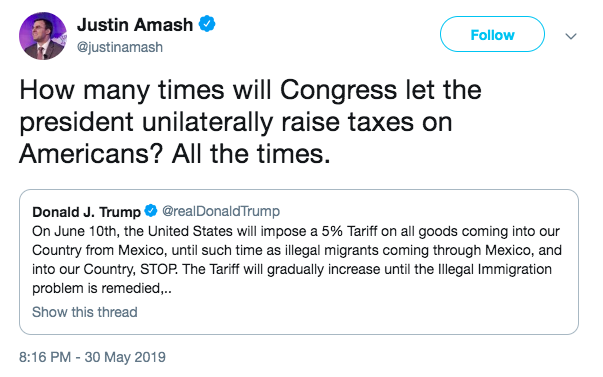
Apparently, the President believes the way to stop migration induced by poor economic opportunity is to undercut Mexico’s economy.
Reminder: tariffs are taxes.
Republicans, who still have memories of the GOP as a party of free trade are upset. Senate Finance Committee Chuck Grassley (R-Iowa) said, “Trade policy and border security are separate issues. This is a misuse of presidential tariff authority and counter to congressional intent”.
The conservative leaning U.S. Chamber of Commerce is considering legal options in response to the duties.
Rep. Justin Amash of Michigan, the new de facto leader of the anti-Trump movement in the Republican Party after his call for impeachment proceedings tweeted:
Finally, this announcement comes as the President is trying to get congressional approval for the new Mexico-Canada-US trade deal. That now becomes less likely.
Bite Sized Politics
- The bipartisan couple no one saw coming: Democratic Rep. Alexandria Ocasio-Cortez and GOP Sen. Ted Cruz agreed on Twitter on Thursday to lead a bill to ban former lawmakers from taking paid lobbying positions.
- Two Navy officials confirmed to CNN Wednesday night that the White House Military Office asked lower-level US Navy officials to keep the USS McCain, named after the late Senator John McCain, out of view during President Trump’s trip to Japan. President Trump famously questioned McCain’s heroism.
- One month after the Israeli election, the Knesset voted late Wednesday to initiate a repeat election on September 17, a blow to Prime Minister Benjamin Netanyahu who failed to form a governing coalition.
- The Pentagon marks an unusual anniversary on Friday: 365 days without an on-camera briefing from a top spokesperson.
- The Trump administration will soon make it easier for adoption agencies to reject same-sex couples, senior administration officials told Axios.
- President Trump allegedly pushed for North Dakota-based Fisher Industries — whose CEO Tommy Fisher donates to the GOP and regularly appears on Fox News — to be awarded a border wall contract, administration officials told the Washington Post.
- Attorney General William Barr is taking a far more expansive look at origin of the investigation into Russian interference than was previously known, according to his Senate testimony Wednesday.
Other cool things:
Via “Republican Justin Amash stands by position to start impeachment proceedings despite criticism”

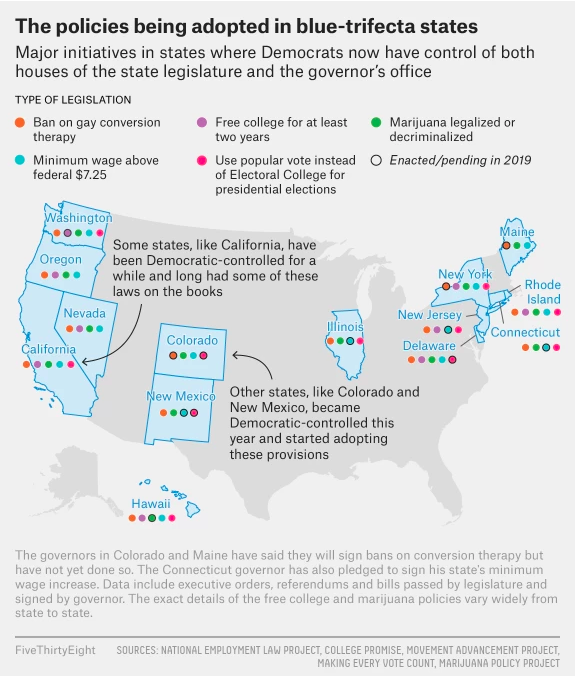
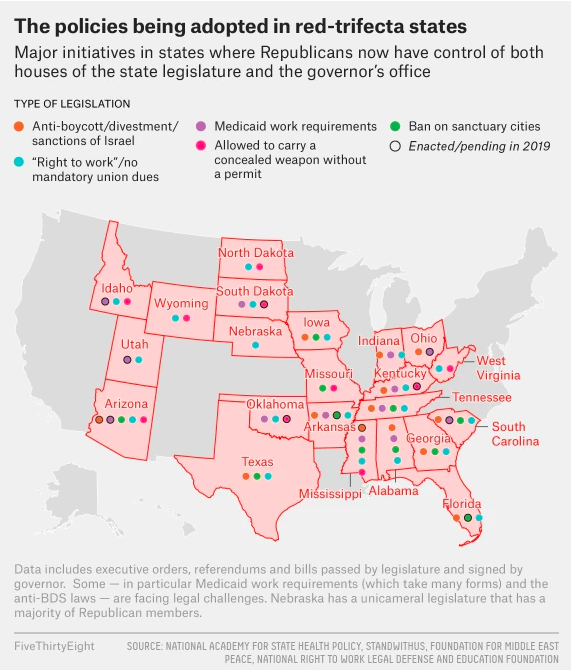
Via “What Republicans And Democrats Are Doing In The States Where They Have Total Power”
Via “How the Rural-Urban Divide Became America’s Political Fault Line”

Thanks,
Crawford
 The Lens